



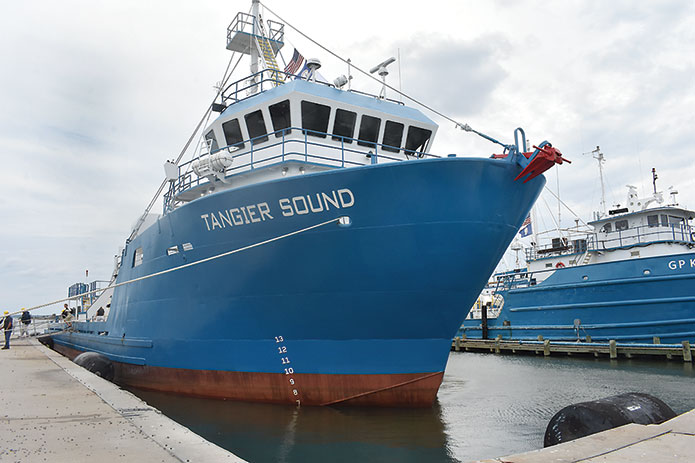
The recent news that menhaden firm Ocean Harvesters is adding a $9 million menhaden vessel, the 165-foot F/V Tangier Sound, to its fishing fleet is sending a message that Ocean Harvesters, Omega Protein Inc. and Canadian parent company Cooke Inc. plan on fishing in the Chesapeake Bay region into the future.
The company has been of late dodging a barrage of opponents up and down the East Coast ranging from Maryland fifth graders writing “hate mail” letters to the firm to “stop killing ospreys”; to advocates throwing blocks in nets; a jet ski running inside a net interrupting sets; a small militia of boats attempting to block sets; environmental groups alleging that overfishing of menhaden is depleting osprey and striped bass populations; and a lawsuit in a southern district of New York federal court alleging that Cooke Inc. had been illegally fishing in U.S. waters because the boats are owned by a Canadian firm. A federal judge dismissed the case in January 2025 allowing Ocean Harvesters to continue to fish.
The jet ski incident occurred Sept. 23, 2023 and brought national attention to the debate that prompted Virginia legislators to pass a “Right To Fish” law to protect menhaden crews and commercial fishing watermen from harassment.
The legislature increased penalties for harassing watermen to a Class 1 misdemeanor, which is confinement in jail for not more than 12 months and a fine of not more than $2,500, either or both.
On Monday, Sept. 15, officials of Ocean Harvesters invited the press for a tour of Omega Protein fish meal and oil plants; a tour of the new vessel; a 45-minute ride on Tangier Sound; and what turned into a three-hour classroom style meeting on why reduction menhaden fishing should continue on Chesapeake Bay.
CEO of Ocean Harvesters’ Monty Diehl addressed each issue with detailed graphs in an effort to counter growing opposition from environmental groups, sports fishermen and a swelling shoreline waterfront landowner demographics — who have no ties to the bay’s seafood/maritime culture.
Virginia has a small purse seine bait fishery that catches menhaden for recreational fishermen and the larger “reduction” fishery so named because of the reduction it makes on the menhaden population. It is the only large menhaden reduction fishery remaining on the East Coast — once allowed by all of the coastal states. Virginia’s reduction fishery was founded in 1867 by Elijah Reed who brought the modern day pogy (menhaden) fishery to Virginia from Brooklin Maine. Reedville is named after Elijah and a statue of him is erected in the town square.
The companies
Omega Protein Inc. is a menhaden reduction fishery composed of fish plants in Reedville; Abbeville, La.; Moss Point, Miss.; and it owns Omega Shipyard in Moss Point. On the Chesapeake and Gulf, Omega Protein processes 437,000 metric tons of menhaden; produces 40,000 metric tons of fish oil; 135,000 short tons of fish meal; and generates $300 million in sales.
Ocean Harvesters, the company that owns and fishes the boats at Reedville, has nine large vessels, six of which are “fish steamers” that harvest 156,000 metric tons annually (51,000 metric tons from Chesapeake Bay); produces 8,000 metric tons of oil; and 40,000 short tons of fish meal. It employees six spotter airplane pilots, 260 Omega/oil employees; 250 indirect employees (outside companies and individuals who do work for the firm); has a $29 million annual payroll (including benefit packages) and makes a $100 million economic impact on Virginia’s Northern Neck and Middle Peninsula, reported Diehl.
History
The firm started in 1878 as the John A. Haynie Co.; Haynie Snow & Co., 1903; Reedville Oil & Guano, 1913; Haynie Products, 1960s; Zapata Haynie Corp., 1970s; Zapata Protein Inc., 1990s; Omega Protein Inc., 1998; and Cooke-Omega/Ocean Harvesters, 2017.
The firm was publicly owned and traded on the New York stock exchange until December 2017 when Cooke Inc. (also known as Cooke Seafood or Cooke Aquaculture), out of Saint John, New Brunswick, Canada, bought Omega Protein Inc. Cooke Inc. owns and operates one of the largest salmon aquaculture businesses in the world and bought Omega primarily because of the high protein fish meal component used as a supplemental food source to grow salmon, swine, poultry, etc., says Diehl.
Mitigation
Efforts by environmentalists, advocates and waterfront landowners to push the menhaden fishery out of Chesapeake Bay have escalated over the last five years. There has been public outcry when net tears result in dead fish floating up on shore and allegations of kills and pollution whether the fishery was involved or not. A recent Facebook post noting public anger towards Omega stated, “Welcome to all the tourists who came to Virginia Beach to enjoy Labor Day weekend! Unfortunately, you cannot go swimming at the beach because our Virginia Marine Resources Commission and Virginia Beach City Government allowed Canadian-owned Omega Protein to pollute the waters off our coast.”

After conflicts escalated between the fishery and recreational elements of the bay, Omega agreed in 2023 to stay one mile off populated areas from Tangier Sound to the bay bridge tunnel on Eastern Shore and from Hampton down to Sandbridge Pier on the western shore; to not fish on weekends between Memorial Day and Labor Day; and to stay a half mile away from the Chesapeake Bay Bridge Tunnel.
Many opponents want the fishery out of the bay and to fish exclusively in the Atlantic Ocean. As reasons for continuing to be able to fish the bay, Diehl says menhaden school in close to shore and 75% of catch is insight of shoreline. If the fishery has to work exclusively in the ocean it would greatly limit profitability.
Diehl says the company has established a mitigation program in an attempt to defuse some of the opposition. The mitigation plan is:
- First priority — fish in the ocean when weather/fish allow.
- Avoid higher risk areas and known hazards (shipwrecks and other obstacles on the bottom that cause net tears).
- Purchase new nets annually; at $75,000 apiece.
- Notify Virginia Marine Resources Commission (VMRC) of any suspected spills.
- Notification even if uncertain of a fish kill.
- Developed “skimmer” capability to capture floating dead fish close to shore.
- Put an environmental contractor on standby.
- Monitor area three to four days after cleanup and report to VMRC.
- Clean up any/all fish which reach shore.
- Reach out to impacted landowners.
Ospreys
Another environmental allegation is that the fishery is depleting the menhaden stock to a point it is starving the bay’s osprey population to death. Ospreys eat menhaden. Diehl presented numerous graphs and slides showing the industry’s side to this debate.
He used the latest United States Geological Survey (USGS) science data to show that fish “species” consumed by ospreys depend on where the birds feed and nest. The graph showed that Atlantic menhaden and Atlantic croaker, in that order, is the primary source of food in the lower bay estuarine areas. “Ospreys do not just feed on menhaden,” said Diehl.
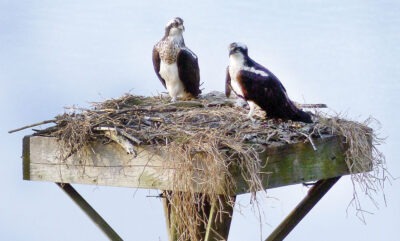 He argued that a recent study on ospreys on Mobjack Bay by Bryan Watts suggesting the osprey population in that area is depleted specifically due to low numbers of Atlantic menhaden is “skewed and inaccurate.” He also said Ocean Harvesters’ boats do not fish anywhere near Mobjack Bay.
Concerning the Watts’ study, Diehl quoted Virginia Institute of Marine Science (VIMS) fisheries scientist Dr. Rob Latour. “To my knowledge his (Watts) work did not involve… menhaden data, or on anything regarding fisheries management. I think it’s a linkage that he made, and I don’t think it can be validated, so we’ve spoken with him about that. We’re trying to work on developing collaborative ideas and better exchange; but my take is we can’t answer the question if management has failed the osprey; or if abundance (food sources) are below levels necessary to support the osprey.”
Dr. Steve Cadrin, Fisheries Scientist University of Massachusetts Dartmouth, according to Diehl says “Academia & Watts (2013) report that nesting osprey in Mobjack Bay have low reproductive rates, and feeding experiments suggest nesting success is food limited. However, their results do not support their broader conclusion about population collapse or recommendations for management of the Atlantic menhaden fishery.”
Omega Protein Director of Public Affairs Ben Laundry said “environmentalists are trying to scare the public into believing that if we are not completely removed from the bay the entire eco-system will collapse. We have been doing this (fishing the bay) for a long time and it has not collapsed.
There's more to this story...
Are you a subscriber? Log in
Many more news articles, photos and ads are available
only to those who subscribe to our
printed newspaper or our online e-Edition.
Pick up a copy or Subscribe today!
| e-Edition | Printed version |