


 by Larry Chowning –
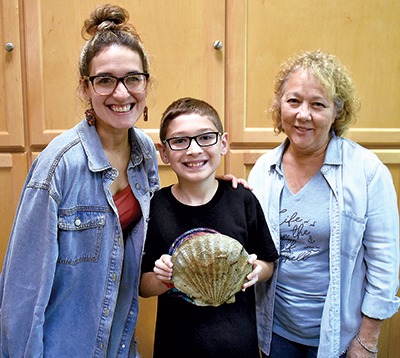
Isaac Griffin, 10, of Athens, Tenn., received the surprise of his life last week when he found an ancient, intact, seven-and-a-half-inch wide/long scallop shell in Urbanna Creek.
The ancient shell is from the Miocene era, which extended from 5 to 23 million years ago and is named Chesapecten middlesexensis, after Middlesex County.
Isaac was visiting his great-aunt and uncle, Kerry and Dr. Jim Robusto of Urbanna, when Dr. Robusto and Isaac went mud-larking along the shoreline. Isaac spotted the big shell. “I had already picked up some smaller shells when I saw the big one,” said Isaac. “I did not realize how big it was until I got it up.”
In 1936, paleontologist Wendell C. Mansfield of the U.S. Geological Survey, of the Smithsonian Institute in Washington, D.C., visited Urbanna Creek and discovered a large extinct species of scallop, never seen before, that he named Chesapecten middlesexensis.
Mansfield had visited the creek banks earlier in 1929 and found a new species of shell then, which he had named Carolinapecten urbannaensis, after the Town of Urbanna.
Along some areas of the high banks on Rappahannock River in Middlesex and on the north bank above the bridge on Urbanna Creek fossil shells from the Miocene era can be found.
Between 2009-2017, paleontologists Edward J. Petuch and Mardie Drolshagen visited Urbanna Creek and found 12 species that had not ever been scientifically identified. In 2009 they named one after, then Urbanna mayor, the late Beatrice Taylor, the first female mayor of the town.
Petuch and Drolshagen wrote a book, “Molluscan Paleontology of the Chesapeake Miocene,” that stated 20 million years ago, Urbanna and Middlesex were in the middle of a huge body of water called the Calvert Sea.
The Miocene era was a time of wildly fluctuating climate here when the Chesapeake Bay region went through subtropical, cold, and temperate periods, they wrote. This resulted in rapid evolution and extinction of species found today in large deposits of fossil shells that are visible in exposed and eroded river and creeks banks and at the bottom of wells in Middlesex County.
Twenty years ago, a perfect sample of Chesapecten middlesexensis was found in the bottom of a well at Shooter’s Hill near Hartfield on the Piankatank River.
Isaac is on fall break from school and returned to Tennessee last week. “I’m taking my shell home and I’m going to take it to school for show and tell,” he said.
Certainly, this will make a great science lesson for Isaac’s classmates and his fall break trip to Urbanna will be one he will never forget.