



The sun is nearing the peak of its 11-year cycle of solar storms, according to scientists.
When it peaks, the sun’s magnetic field reverses — the north pole becomes the south pole, and the south pole becomes the north pole.
As the poles reverse solar storms increase and the sun ejects more charged particles. “Coronal mass ejections” spew billions of tons of matter traveling at 1 million miles per hour.
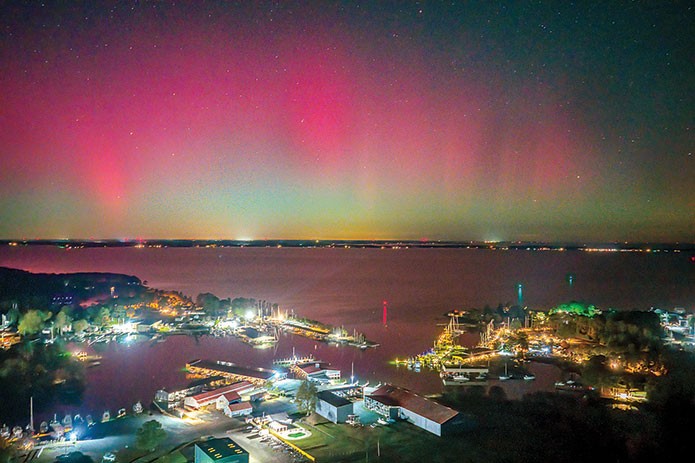
Normally, the sun continually sends out “solar winds” and as these particles near the Earth the Earth’s magnetic field deflects these solar particles toward the poles. This is the origin of “northern lights.”
However, during a coronal mass ejection, the vastly increased amount of sun-charged particles pushes the aurora further away from Earth’s poles and makes them visible further to the south (in the northern hemisphere).
The sun’s energized particles collide with different gases in the Earth’s atmosphere, giving the spectacular phenomenon known as the aurora borealis.