


Unmanned aerial vehicles fertilize Middlesex fields
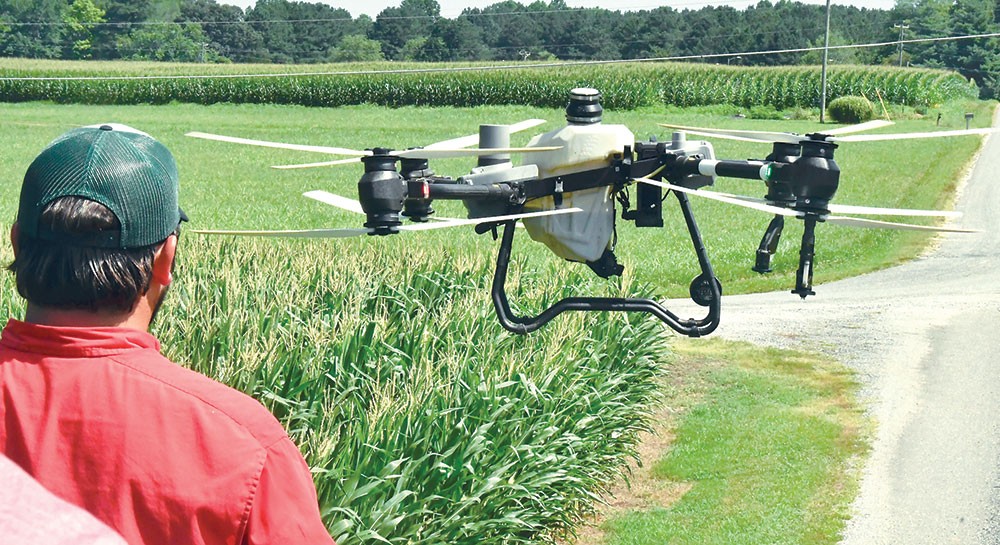
This summer, CLAS Corporation LLC of Saluda contracted to have some of its cornfields sprayed with fungicide and fertilizer, explained Allen Hunt, who with his father Chuck, owns CLAS. “We utilize technology to maximize efficiency,” said Allen Hunt. “Fungicide helps to mitigate stress in a crop” and sprayed fertilizer is absorbed through the leaves of the corn plant.
“We rely on advice from our agronomist to make informed decisions on products and timing of application,” said Allen Hunt.
Drones are nimble and can fly where crop dusting planes cannot. When mapped properly, drones can fly around power lines that cross the field and are better suited for some fields where airplane application is not. These drones have full radar and camera systems to avoid obstacles. “Drones do not replace planes,” said Allen Hunt. “They are just another tool to use.”
Mapping
Drones are nearly autonomous. They start by mapping a field to set boundaries, then create a pattern to cover all the field.
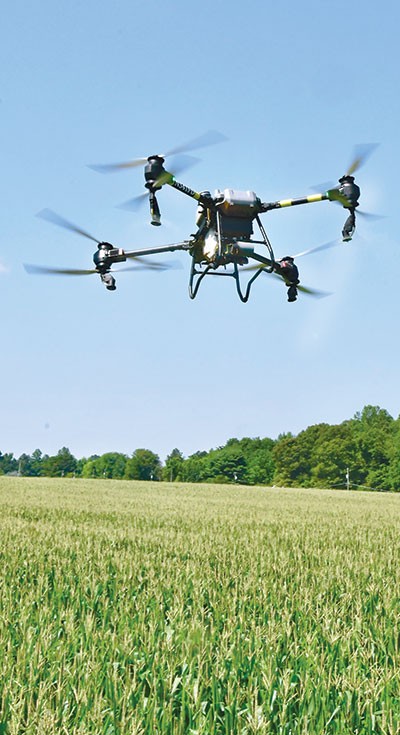 After filling the spray tank and putting in a fresh battery, the operator puts the drone in the air and the drone takes control, flying in patterns that maximize efficiency, said licensed drone pilot Connor Bradley, 21, of Mechanicsville, who operates Old Dominion Aerial and is a senior at Liberty University in Lynchburg studying civil engineering. Drones are relatively efficient, said Bradley.
“When we fly three drones at a time we can cover 75 acres in an hour.”
Bradley works with M&L Land and Wildlife LLC, headed by owner Jake Fletcher, a Deltaville native who now lives in Bruington in upper King and Queen County.
“Because we map the fields beforehand we are able to let the drones fly fully autonomously which allows for full coverage with high safety,” said Bradley.
Fletcher explained that the technology these drones are providing, along with the expertise of someone like Connor, the margin for error or off-target applications is very slim due to the preciseness of the applications.
Other uses
“Fungicide and insecticide protect and elongate the corn’s lifecycle when it is most vulnerable to diseases,” said Fletcher. However, drones are a tool to implement just about any land management desired. Fletcher’s company, M&L Land and Wildlife, is multi-faceted offering land, farm, and wildlife management including conservation recommendation and is a consultant and contractor to retain wildlife habitat goals on landowners’ property. M&L is listed as a consultant with the Virginia Department of Forestry and has partnered with multiple conservation groups to enhance wildlife habitats and protect native species, explained Fletcher.
M&L also specializes in “controlling and suppressing” invasive species that are a threat to critical native wildlife habitats. Species such as Ailanthus trees and Sericea Lespedeza that were introduced from foreign countries to help solve a problem are now causing major issues far beyond their intended purposes. Fletcher has also worked with the Virginia Department of Transportation (VDOT) to establish wildflower and meadow areas across the state which create feeding and nesting habitats for the monarch butterflies that migrate from Canada to Mexico. He’s planted 40 acres so far this year…
There's more to this story...
Are you a subscriber? Log in
Many more news articles, photos and ads are available
only to those who subscribe to our
printed newspaper or our online e-Edition.
Pick up a copy or Subscribe today!
| e-Edition | Printed version |