



On the side of Route 33 at Cooks Corner is a brick building that has been there longer than many people today have been alive. Most speed past taking it for granted.
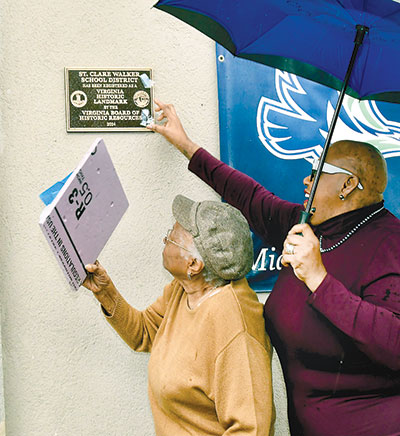
But for many others it represents a genesis. Within the walls of what was then St. Clare Walker High School and on its campus, opportunities awaited young African-American children. Education gave them hope and a foundation for a better life.
At long last, the significance of this 86-year-old structure has been certified. In 2024, it was listed as a Virginia Historic Landmark by the Virginia Board of Historic Resources, and in 2025 it was listed on the National Register of Historic Places by the U.S. Department of the Interior.
Two plaques attached to the front of the former St. Clare Walker High School attest to the historical significance of this revered building. The state and federal status will make future grants more likely, said David Brown, PhD, co-director of the Fairfield Foundation, which is assisted by The Heritage Committee. “These nominations capture a moment in time,” he said at Saturday’s dedication. “What’s important to me is the community comes together to write [the history].”
The Fairfield Foundation merely provides guidance to get the words in a format that show the state and federal agencies the importance of a place, he added.
Campus
St. Clare Walker High School consisted of three buildings, explained Jamaica resident Bessida Cauthorne White, a board member of The Heritage Committee of Middlesex County. The brick building was the primary building. In it were classrooms, auditorium, administration offices, library, and a gymnasium, said White. Next door was a white wooden frame building that housed a shop and agriculture classes and the cafeteria. The metal building behind the white building housed fifth, sixth and seventh grades for a few years beginning in the 1959-1960 school year.
“The St. Clare Walker School community was a nurturing community,” explained White. “The teachers cared deeply about the students, lived in the community with them, went to church with them, and were very much a part of their lives.”
White’s comments followed the St. Clare Walker High School 2025 school-wide reunion conducted on Nov. 22.
Middlesex County had a Black high school before most of the other Middle Peninsula counties did, and Middlesex Training School was fully accredited by the state in 1931, explained White.
Foundation
Lucy Thornton Edwards, who lived in West Point, attended St. Clare Walker High School, graduating in 1957. “Mr. St. Clare Walker told us we could go far,” she told the audience at the unveiling. “It was the background that I got here that kept us going.”
Fire
St. Clare Walker High School came about after a fire destroyed the Middlesex Training School in Syringa in 1936. “After identifying the need for a modern building, Black citizens formed the Middlesex County Steering Committee and purchased land which was conveyed to the [Middlesex] county for a high school. Through community advocacy and with the aid of New Deal funds, a new brick high school was built at Cooks Corner,” states a history program that was part of the reunion conducted in November.
The new school opened in 1939, and in 1949, the school was named in honor of Middlesex native John Henry St. Clare Walker, who had begun his tenure as principal in 1920 serving almost 20 years. After stepping down as principal, Mr. Walker taught mathematics at the school until the end of the 1958-1959 school year. He died in 1960 at the age of 61.
India Banks Foster penned a tribute “To John St. Clare Walker” that reads in part:
“Dedicated to help youth on their way
To build their ideal standard high
These walls hold fond memories past
Of one whose life was lived so well.”
Integration
In 1954 the U.S. Supreme Court Brown v. Board of Education lawsuit ruled that racially segregated schooling was unconstitutional.
“Multiple school systems in Virginia introduced Freedom of Choice plans,” states the reunion history. “From 1963 until total integration in 1969, African-American students at St. Clare Walker High School could choose to enroll at the previously all-white Middlesex High School located in Saluda. Thirteen students enrolled to desegregate Middlesex High School and Middlesex Elementary School at Saluda in September of 1963. Other African-American students elected to attend white schools under Freedom of Choice before total desegregation.”
In 1969, St. Clare Walker High School closed, ending segregation in public schools in Middlesex.
The school was then used by the Middlesex County Public Schools system as a middle school until 1994 when the new middle school bearing the same name opened in Locust Hill.
Reunion
About 200 persons attended the St. Clare Walker High School reunion on Nov. 22 at the Beacon center at the Pilot House Inn in Topping, coming from as far away as Florida, California, and the Midwest.
The oldest person present was Carstella Wake West, 96, who was the valedictorian of the class of 1946.
Also in attendance were two former St. Clare Walker High School teachers, Dr. Alvin C. Lomax and Alice Thornton Edwards, who are both older than 90 years of age.